
5 Essential Tools Every Financial Analyst Should Use for Better Insights
Introduction
Financial analysts play a significant role in the interpretation of data, trend forecasting, and provision of insights to drive business decisions. Analysts require the right tools to enhance their analysis and streamline their processes in this field. Here are five essential tools every financial analyst should consider using for better insights.
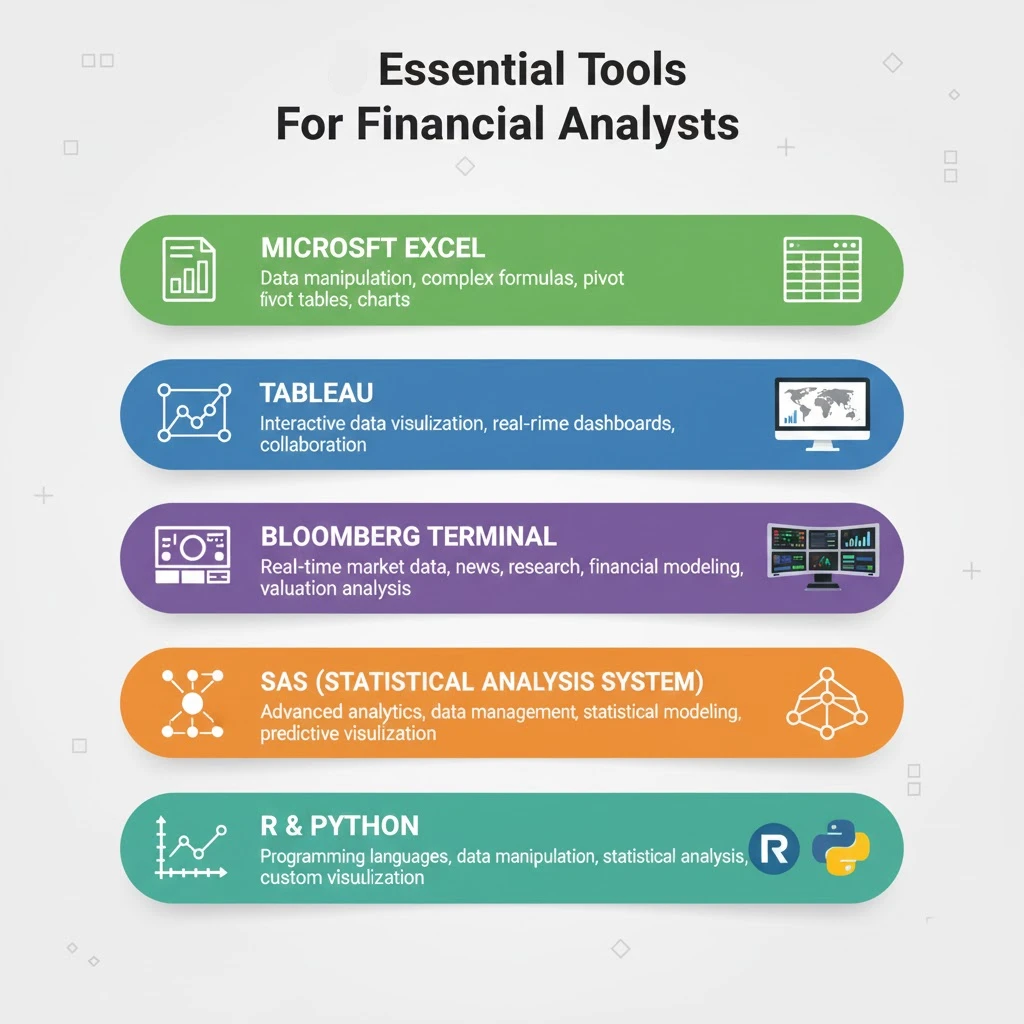
1. Microsoft Excel
It is a core tool for the financial analyst in Microsoft Excel. It is a richly featured application that allows manipulation, analysis, and visualization of data. Its use is indispensable to anyone involved in finance.
- Formulas and Functions: Excel supports complex calculations through a set of built-in functions that analysts can use. They range from simple arithmetic functions to more complex financial ones, such as NPV (Net Present Value) and IRR (Internal Rate of Return), which enable detailed financial modeling.
- Pivot Tables: Pivot tables enable analysts to aggregate large datasets in a swift manner. They can accumulate data and generate dynamic reports, making it easier for the analyst to analyze the trends and patterns.
- Charts and Graphs: Excel provides a range of charting options that facilitate visualization of data. Complex information becomes more digestible for stakeholders with the aid of visual aids.
- Because many businesses already have Excel, it is a low-cost solution. Additionally, because it is compatible with most other software, it makes data integration easy. There are also online resources and community support that analysts can tap into to continue developing their skills in Excel.
2. Tableau
Tableau is an excellent tool for data visualization where analysts can change complicated data into interactive and understandable visual representations. An interface-friendly user allows creating dashboards that make insights communicate effectively.
- Drag-and-drop functionality this characteristic of the system makes it simple to create visualizations. Analysts can immediately and with minimal training manipulate data, and even the appearance of the visuals.
- Real-time data analytics: Tableau can connect to real-time data sources and render these in real-time. In business, it is essential for timely information in decision making.
- Collaboration Tools: Tableau allows teams to share dashboards and reports easily. This collaborative aspect fosters communication among stakeholders and enhances decision-making.
- Collaboration Tools: Tableau's ability to present data visually helps stakeholders understand complex information quickly. By turning raw data into engaging visuals, analysts can effectively communicate their findings and drive strategic discussions.
3. Bloomberg Terminal
Bloomberg Terminal is the most elaborate financial software system. It contains real-time market data and news and analytics that are broadly used by investment professionals and financial analysts because of its expansive database and tools.
- Market Data The Bloomberg Terminal provides real-time data on the stocks, bonds, commodities, and currencies. This has allowed analysts to monitor any movement in the market while making appropriate decisions.
- Research Tools Analysts can have easy access to a lot of research reports, financial statements, and company profiles. Such resources allow for deeper analysis and benchmarking against industry peers. It also includes integrated analytics functions that allow the user to model financial scenarios for a valuation analysis.
While expensive, the Bloomberg Terminal does offer a level of information depth and analytics capabilities that can really enhance the analyst's ability to make decisions on data. It's most useful for investment bankers, traders, and asset managers, where having up-to-date information is the most important thing.
4. SAS (Statistical Analysis System)
SAS is an environment for advanced analytics, business intelligence, and data management and has comprehensive statistical analysis, which makes it worth focusing for financial analysts.
- Data Management: SAS is excellent at managing large datasets and permits the analyst to clean, manipulate, and analyze data at high performance.
- Statistical Analysis: SAS offers a host of statistical procedures and modeling techniques that include regression analysis, time series forecasting, and risk modeling. It would use predictive analytics in terms of analyzing any trend and coming up with a forecast that should happen based on historical data.
SAS has an advantage for financial analysts dealing with advanced analysis requirements or large datasets since its statistical capabilities can be used to enable powerful predictions in trends and correlations that fail to surface in simple analysis.
5. R and Python
R and Python are very popular programming languages in terms of data analysis and financial modeling. Both tools are gaining much popularity among the financial analysts because of the flexibility and power they give.
- Data Manipulation: The R and Python languages come with libraries that are set to manipulate data. The former has pandas for the latter dplyr, so the two make it possible to simplify the cleaning process and preparing data for analysis.
- Statistical Analysis: R, in particular, is known for its strengths in statistics, hence suitable for analysts who want complex analyses. Statistical libraries in Python are equally robust through SciPy and Stats Models.
- Visualization: There are two languages with really good visualization libraries. The language, ggplot2 in R and Matplotlib or Seaborn in Python allows analysts to make meaningful graphs and charts. Advantages Those who use R or Python enhance their ability to conduct in-depth analyses and automate repetitive tasks. Both languages are open source, and therefore their cost is nothing.
Conclusion
A study by today's fast-changing financial world requires adequate tools to make a valid output from the study of the analyst. The tools and its merits help an analyst get a head start ahead with the aid of Microsoft Excel, Tableau, Bloomberg Terminal, SAS, and programming languages R and Python. So, by adopting the instruments listed above, an efficient flow of work by smart decision-making will ascertain the fruitful accomplishment of an organization. These technologies enhance the quality of analysis and also impart the ability to analysts to communicate their results very effectively.