
How All Three Financial Statements Are Interlinked
Introduction
The financial statements are the cornerstones of financial reporting and analysis. It is a standardized way that the financial performance, position, and activity of a business are reported to various parties that generally would be considered to have a vested interest in the finances of a publicly traded corporation. These could include stockholders, bankers, government regulators, financial analysts, and managers. Even though the statements are different, the Income Statement, Balance Sheet, and Statement of Cash Flows, for example, are not standalone statements but are interwoven as part of a single financial tapestry that tells the story of a business.
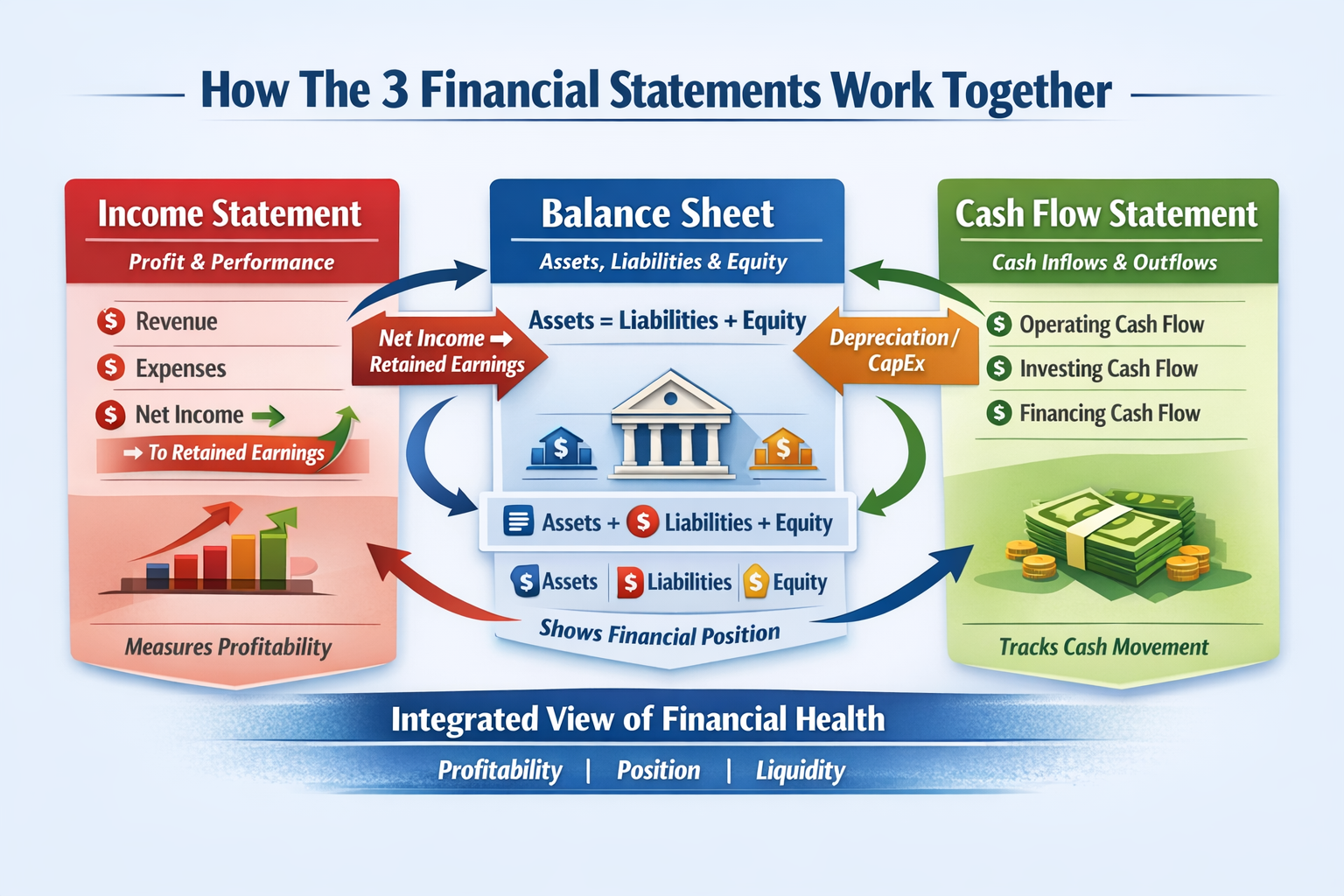
Three Financial Statements - An Analysis
Single-issue analysis of statements needs to be done to assess the inter-linkages.
1. Income Statement (Profit & Loss Statement).
The Income Statement is a documentation which reflects the financial performance generated by any business entity on certain grounds; this may be quarterly or even annually. To define it more concisely, an income statement is a description of how the revenues generated in a business are translated into net income.
Main Elements:
•ROI
•Cost of Goods Sold (COGS)
• Gross Profit
•OPERATING EXPENSES
• EBITDA
• Maintenance cost
• Operating Profit (EBIT)
•Interest Expenses
• Taxes
•Net Profit (Net Income)
Main Aim:
The calculation of profitability and efficiency on any given set of periods of time.
2. Balance Sheet
The Balance Sheet represents the financial situation of a business at any one given moment in time. It is built on the accounting equation:
Assets = Liabilities + Shareholders' Equity
Key Components:
•Assets [Current & Non-current]
• Liabilities (Current and Long)
•Equity (Share Capital, Retained)
Main Objective:
This is important in showing what it has, owes, and what remains for the shareholders.
3. Cash Flow Statement
The Cash Flow Statement describes the inflows and outflows of a company during an accounting period. The Cash Flow Statement is adjusted to correspond with net income.
Sections:
• Cash Flows from Operating Activities CFO
• Cash Flows from Investment Activities, or CFIA
Timing of Cash Flow from Financing Activities. CFF
PRIMARY PURPOSE:
• To assess liquidity, cash generation, and sustainability.
• Business Analysis Tool.
• The Basic Logic of Interlinkages
• These three statements are interconnected in that they represent different facets of the same phenomenon:
• The Income Statement is used to compare performance profitability
• The Balance sheet shows position (resources, liabilities).
• The Cash Flow Statement is a measure of movement - cash effect.
• At least in every financial transaction, there exist two statements and sometimes three.
Linkage 1: Net Income Connects the Income Statement and Balance Sheet
Net Income Flow
Net Income is the most significant connecting figure that connects the Income Statement with the Balance Sheet.
• The Net Income is calculated at the bottom of the Income Statement.
• What's more, net income is carried over to the "Retained Earnings" account in the Shareholders' Equity section of the Balance Sheet.
Formula:
Closing R/E = Opening R/E + Net Income – Dividends
Why This Matters
• Successful businesses add equity.
• LOSING BUSINESSES ERODE SHAREHOLDER VALUE.
It refers to profitability that has accumulated.
Hence, the Income Statement has an indirect effect on the Balance Sheet through retained earnings.
Linkage 2: Depreciation and Amortization
Income Statement Effects
• Depreciation is considered to be a cost; therefore, it affects the bottom line and consequently reduces net income.
• It is a noncash expense.
Balance Sheet Effects
• It decreases the book value of fixed assets. It is referred to as depreciation since the
• Accumulated depreciation keeps on increasing.
Cash Flow Statement Analysis
•Such depreciation is added back because it is a noncash item.
• The formula only accounts for the derivation of Net Operating Profit from
Summary of Interlinkage
"However, one expense at the same time
• Reduces Profit (Income Statement)
• Lessens asset value-Balance Sheet
• Increases operating cash flow (Cash Flow Statement)
Linkage 3: Working Capital Changes
• Change in Working Capital
• "Working capital accounts have one of the highest cross correlation coefficients involving all three statements,
Classification, later, is:
Factors determining working capital requirements:
• Accounts Receivable
• Accounts Payable
• Other Current Assets and Liabilities
Example: Accounts Receivable Increase
• Income Statement
• Revenues are recognized when earned, even when cash has not been received.
Balance Sheet
• The accounts receivable, which means the customer's debt, is increased
Statement of Cash Flows
This increase in the accounts receivable balance is then deducted from cash flow from operations.
Interpretation
• The Business is generating revenue but is failing to Collect Cash.
• Example: Inventory Increase
The effect of a buying cost on profit for a firm may not be immediate
• Your hearing is heightened on the Even
• Cash position is reduced, hence affecting the operating cash flow.
Example: Accounts Payable Increase
• EXP
• The payment is late.
• The cash flow position temporarily improves.
Linkage 4: Capital Expenditure (Cap Exp)
• Capital Expenditure (Cap Exp This means that the capital expenditure is tied to the investment, which ties all three statements together.
• Balance Sheet Effects Although a balance sheet is a snapshot
• Fixed Assets increase when Cap Exp is experienced.
INCOME STATEMENT EFFECTS
• It does not affect profitability.
•Depreciation cost rises with the passage of time Effects on the Cash Flow Statement
cash inflow from Investing Activities. This is because high growth firms can show the following:
•LOW or negative free cash flow
•Sufficiency revenue growth
•Raising asset base
Linkage 5: Debt and Interest
Always Raising Debt
•Balance Sheet: Liabilities –
•Cash Flow Statement: Funding cash flow.
•INCOME STATEMENT: No impact is created.
Interests Expenses
•INCOME STATEMENT: Decreases Profit.
•Balance Sheet: Cash, cash equivalents, accounts receivable, accounts payable
•BALANCE SHEET: Cash decreases; retained earnings decrease. Linkage.
Linkage 6: Equity Issuance and Dividends
• BALANCE SHEET: Share capital is increased.
• CASH FLOW STATEMENT: The cash flow from financing.
• INCOME STATEMENT: Not Directly Affected Paying Divid
• BALANCE SHEET: The retained earnings section is .
• CASH FLOW STATEMENT: Sources (uses) of
• BALANCE SHEET: No effect (funds are not invested). .
Cash Flow Statement as the Connector:
The Cash Flow Statement connects or bridges the two statements, namely the Income Statement and Balance Sheet.
It is the fact that:
• Net income represents the beginning
• Closes the non-cash items
• Accounts for Changes in Balance Sheet
• Explains cash movement
• That being said, it makes it the most crucial tool for:
• Liquidity analysis
• Analysis of the quality of earnings
• Financial health assessment
• Integrated Example: One Transaction
Example: Sale on Credit for ₹ 10,00,000
• Income Statement: Income increases
• Accounts receivable
• increases- balance sheet
• Cash Flow Statement: No cash inflow arises immediately.
Later (when the cash is collected):
• Accounts Receivable - Balance Sheet: Receivables decrease, cash increases
• cash flow statement - operating cash inflow
.
Importance of Interlinkages in Financial Modelling:
These interlinkages indeed form the backbone of financial models.
Overview In integrated financial models
•Income Statement drives retained earnings
• Automatic Balance Sheet balances
• Statement of Cash Flows: This describes the cash changes.
The inappropriate usage of one statement has brought down the whole model.
Relevance of Value
• Cash flows are used by DCF.
• These cash flows result from the Income statement and balance sheet.
• Working capital and Cap Exp assumptions count materially.
• It ensures that linkages are correctly valued.
Role in Credit Analysis
Lenders pay close attention to the following:
• Cash generating capabilities
• Capability of debt-servicing
• Strongness of balance sheet
A company can well generate profits but still be insolvent-only integrated analysis would reveal this.
.
Common Mistakes Due to Poor Understanding:
• Confusing cash with profit
• Evaluate performance without considering the effect of operating capital
• Ignoring noncash expenses
• Mismeasuring Asset Growth
These can only lead to flawed investment decisions.
Case 1: High growth start-ups
Strong income growth
• Full negative cash flow
• High Cap Exp and working capital investment
Case 2: Mature Firms
• Stable income
• Strong operating cash flow
Dividend pay-out Analytical Ratios and Interlinkages
Many ratios draw from multiple statements:
• ROE = Income Statement + Balance Sheet
• Free Cash Flow: All three statements
•Debt-to-Equity: The Balance Sheet
• Interest cover: Income statement This again reinforces the need for integrated understanding.
Dynamic Interdependence of Financial Statements in Business Decision-Making
While the mechanical linkages among the income statement, balance sheet, and cash flow statement are well understood at a technical level, the dynamic interdependence of the three statements becomes far more apparent when management decisions and external shocks are introduced. The financial statements are not static documents but instead change continuously due to operational strategies, financing choices, and general economic conditions.
Strategic Decisions and Statement Interactions
Thus, when management decides to expand operations, the consequences do not show up in only one statement. For instance, opening a new manufacturing facility may first lead to an increase in capital expenditure that shows up as an outflow from investing activities. The same decision changes the balance sheet in one period due to the increase in fixed assets and the income statement in subsequent periods because of increased depreciation and higher operating costs. Eventually, assuming the expansion is profitable, revenue growth will boost profitability, retained earnings will increase, and operating cash flows will improve. Therefore, one strategic decision ripples across the statements for multiple periods.
Impact of Economic Cycles
Economic cycles further illustrate how the financial statements are interdependent: if the economy is experiencing a slowdown, the sales of the company can be slow, which reduces income with commensurate lower retained earnings. The same economic slowdown has a result of slowing down the collections and, therefore, inflates receivables and also adversely affects the cash flows from operations. The entity may look at drawing additional debt to survive, which inflates liabilities and increases interest costs in succeeding periods. On the other hand, when there is an economic boom, the pace at which the receipts are collected accelerates, the inventory turnover increases to cater to demand, and resultant cash generation is robust. The good cash generation positively affects the strength of the balance sheet by way of being able to pay dividends or retire debt. These cyclical impacts could not have been gauged with any one statement in isolation.
Quality of Earnings Assessment
Interrelationships also play a vital role in assessing the quality of earnings. High reported profits not substantiated by operating cash flows provide evidence of aggressive revenue recognition or inefficient working capital management. On the other hand, accounting profits combined with strong cash generation may reflect conservative accounting practices and a sound business model. Analysts therefore cross-check income statement results with their consequences on balance sheet trends and cash flow sustainability as a means to decide whether such earnings are replicable and trustworthy. .
Long-Term Financial Sustainability
In the end, a company's long-term financial sustainability is determined through the interconnection among all financial statements. Growth that is totally debt-financed could favour short-term profitability at the detriment of the balance sheet and cash flow. Sustainable growth is where profitability, asset efficiency, and cash generation all align. This balance could only be assessed when all three financial statements are put together and considered as an integrated system instead of separate reports.
Timing Differences Between Accounting and Cash Reality
Perhaps one of the most important things one learns from interlinkages is timing differences between the occurrence of an accounting event and the movement of cash. Accounting, for one, has its emphasis on accruals, which quite often differs from the actual cash behaviour. To take a simple example, a long-term service agreement may show revenue being accrued over time when perhaps cash had been received either upfront or in sporadic instalments, thereby giving rise to deferred revenue on the balance sheet and lumpy flows from operating activities. Analysts who project forward profit numbers may go very wrong in terms of liquidity and solvency unless they connect the accrual income into changes in the balance sheet and cash flow patterns.
Conclusion
The Income Statement, Balance Sheet, and Cash Flow Statement are not stand-alone reports but three integrated lenses through which a company's financial reality is viewed. Together, they answer:
• How value is created - Income Statement
• Where value resides - Balance Sheet
• How value moves Cash Flow Statement
Mastering their interrelationships turns financial analysis from mechanical number-crunching into real financial insight. Be it a student, an analyst, an investor, or a decision-maker, the understanding of how all three financial statements are tied together forms the bedrock basis for any form of sound financial judgment.