
How Financial Analysts Collect and Organize P&L, Balance Sheet and Cash flow Data
Introduction
Financial analysts are at the centre of the corporate finance, investment banking, equity research, private equity, and strategic planning worlds, as their function is typically to collect and refine raw financial data into digestible and usable pieces. Their analysis is heavily dependent on the three fundamental financial statements: the Profit and Loss Statement (P&L or Income Statement), the Balance Sheet, and the Cash Flow Statement.
These may be polished and put-together statements of reports, but gathering and structuring the underlying data is by no means simple. It involves the sourcing of data, normalization, cross-checking, reconciliation, and formatting to ensure that financials are reliable and ready for decisions.
.
Financial analysts are responsible for converting raw financial data into meaningful insight to enable strategic decision-making. Much of their work involves modelling, forecasting, and reporting based on the three key financial statements- the P&L Statement, Balance Sheet, and Cash Flow Statement. Before modelling, forecasting, and reporting may start, however, an analyst needs to first obtain, clean, organize, and structure the underlying data. It is a necessary first step that requires technical precision, accounting knowledge, process discipline, coordination across functions, and increasingly, automation and engineering of data.
This article will look in detail at how financial analysts collect and collate the data behind the financial statement, highlighting typical workflows, common complexities, tools used, and best practices across modern finance functions.
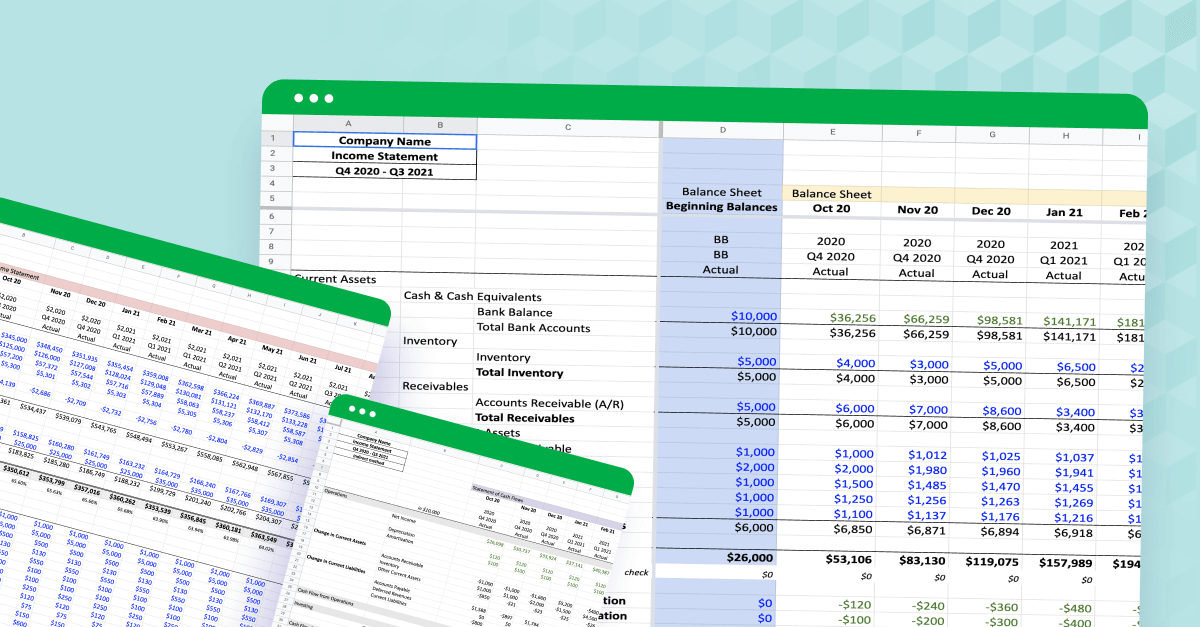
Role of statement
Before discussing the collection process, it is important to clarify what role each statement plays.
The P&L summarizes the performance of an organization over time, generally monthly, quarterly, or annually. It includes: Revenue and sales breakdowns, Cost of goods sold (COGS), Gross profit, Operating expenses (SG&A, R&D, marketing, admin), EBITDA, Depreciation & amortization, Operating income (EBIT) and Interest, taxes, and net income. Analysts use it to analyze profitability and operational efficiency.
The Balance Sheet reflects the financial position of the company at a particular date.
•
• Liabilities– current (payables, short-term debt) and long-term (loans, deferred taxes)
• Equity– capital stock, retained earnings, reserves
The Balance Sheet is foundational with regard to assessing liquidity, leverage, and capital structure.
The Cash Flow Statement translates accrual-based accounting into actual cash flow.
• It is divided into: Operating activities– cash generated from core operations
• Investing activities– cash used for long-term investments, acquisitions, asset purchases
• Financing activities– debt issuance/repayment, dividends, share repurchases
Analysts depend on this data to comprehend a company's true ability to generate cash.
The financial analysts follow a very structured and layered process for data collection in developing the P&L, Balance Sheet, and Cash Flow. To begin with, raw financial data has to be garnered from various internal systems-inclusive of an Enterprise Resource Planning or ERP platform which integrates core business functions. These would include SAP, Oracle, NetSuite, Microsoft Dynamics among others, storing critical financial modules such as General ledger (GL) entries, which forms the foundation of all accounting data. Accounts Receivable (AR) pertains to customer invoices and collections while Accounts Payable or AP entails vendor payment and expenses. There's also Fixed Assets, which deals with depreciation, capital expenditure, and asset lifecycle data. Next are the Inventory modules that record the stock levels, valuation, and movements of such stock. Payroll and HR handle compensation, benefits, labor costs, while Treasury handles cash balances, loans, and banking transactions. From these modules, what analysts typically extract are trial balances, transaction-level journal entries, subledger aging reports, bank statements, depreciation schedules, and inventory counts and valuation reports. Apart from these system data, analysts also draw upon financial and nonfinancial inputs from business functions such as sales operations, including sales orders, bookings, and pricing; supply chain teams, which cover inventory adjustments and freight costs; HR or headcount reports and salary breakdowns; Marketing or campaign expenses; and Manufacturing Plants or production costs and BOM usage.
These are necessary inputs because financial systems rarely capture the full picture of what is required in reporting.
In addition, analysts also use external filings like SEC reports (10-K, 10-Q), annual statements, competitor financial statements, Investor presentations, earning call transcripts, and third-party databases such as Bloomberg or Capital IQ, which may be especially useful for competitive or market analysis. These Rating agencies and regulatory documents.
Once sources are identified, the financial Analyst needs to extract data accurately, timely, and consistently or the purpose determines the level of detail and the time period required.
In addition, analysts also use external filings like SEC reports (10-K, 10-Q), annual statements, competitor financial statements, Investor presentations, earning call transcripts, and third-party databases such as Bloomberg or Capital IQ, which may be especially useful for competitive or market analysis. These Rating agencies and regulatory documents.>
Once sources are identified, the financial Analyst needs to extract data accurately, timely, and consistently or the purpose determines the level of detail and the time period required.
Common objectives
• Budgeting and forecasting
• Valuation modelling (DCF, comparable company analysis)
• Performance dashboards
• Financial risk assessment
• Variance and trend analysis
• Governance and compliance reporting
Depending on the maturity of the company, analysts may be extracting data through: Direct ERP queries, SQL scripts in data warehouses, ETL tools like Alteryx or Informatica, Automated API connectors between systems, RPA bots for systems without APIs and Periodic exports of GL or sub-ledger data (CSV/Excel downloads).
Data Collection
Income Statement Data Collection
Analysts gather: Revenue by segment/geography, Discounts, returns, deferred revenue adjustments, Direct costs and overhead allocations and non-recurring items (restructuring, impairments)
Extraction may be: Automated (via ERP reports), Manual (Excel dumps from accounting) and Augmented using BI tools (Tableau, Power BI)
Balance Sheet Data Collection
Most Balance Sheet data come from: GL trial balances, Subledger reports, Inventory and fixed asset registers and Loan schedules.
Analysts also verify: Working capital components, Book values vs. fair values and Reconciliation between periods
Cash Flow Data Collection
Cash flow often requires reconstructing the statement using: Changes in balance sheet accounts, Adjustments from the income statement, Cash vs. non-cash activity identification, Capital expenditure schedules and Financing transactions.
For many companies, the Cash Flow Statement is not stored as a single dataset but must be calculated.
In modern organisations much of this process is automated. Smaller companies may still rely on manual downloads and Excel processing.
Data collection has a step of normalization and cleaning, in which the analyst maps each general ledger account to reporting categories that are standardized using a Chart of Accounts. This ensures uniformity in revenue, expenses, asset accounts, liability accounts, and equity accounts across business units and periods. During this step in the process, analysts also make adjustments and reclassifications.
Accrual accounting requires several adjustments to develop the financial statements, normally including the following: Accrued expenses not yet invoiced, Deferred revenue recognition adjustments, Amortization of prepaid expenses, Capitalization of long-term investments, Depreciation and amortization, Reclassification of expenses incorrectly posted, and Revaluation of foreign currency–denominated accounts. Analysts make sure such adjustments are correctly represented before compiling the statements. For companies with several subsidiaries, analysts should consolidate financials by applying intercompany eliminations, or loans/transactions between subsidiaries, calculating minority interest, and doing currency translations under either IAS 21 or ASC 830. This will ensure that the final statements accurately show the financial results of the consolidated group. The steps discussed above ensure that the financial data is presented in compliance with the standards laid down either by Generally Accepted Accounting Principles or International Financial Reporting Standards and internal reporting policies.
After cleaning and mapping, analysts start building the P&L, Balance Sheet, and Cash Flow statements. The P&L is compiled by adding up revenues categorized or grouped by type: product revenue, service revenue, subscription or recurring revenue, contract revenue based on percentage of completion, and discounts, returns, and allowances; cost of goods sold, which includes direct costs like raw materials, direct labor, manufacturing overhead, freight-in, and warehousing; operating expenses and margin, where operating expenses are subcategorized into Sales and Marketing, Research and Development, General and Administrative, and Depreciation and Amortization to compute gross profit, operating income, and net income. The Balance Sheet is a representation of the financial position of a firm at any one point in time. Analysts construct it by organizing the ending balances of assets, liabilities, and equity. The construction of a Balance Sheet involves obtaining the ending balances of accounts and ensuring that assets equal liabilities plus equity. This takes in reconciliations of bank accounts, aged receivables and payables verification, updating of depreciation schedules, and the review of inventory valuation. The Cash Flow Statement is usually the most complicated; it connects the P&L and the Balance Sheet by starting with net income, adjusting for non-cash items, factoring in working capital movements, and adding investing and financing activities to derive the movement in cash during the period.
Once the financial statements are built, analysts perform extensive validation and reconciliation to make sure the data is accurate and internally consistent. They check that retained earnings reflects changes in net income, cash balances agree to bank records, sub-ledgers agree to the general ledger, and support a multi-period variance analysis for the detection of anomalies. Advanced teams automate much of this process using SQL pipelines, Python scripts, ETL tools, FP&A platforms like Anaplan or Adaptive Planning, and business intelligence systems like Power BI or Tableau. These tools organize the cleaned and validated financial data into models, dashboards, and reporting packages used by executives, managers, auditors, and investors for decision-making, budgeting, forecasting, and financial performance monitoring.
Once the financial statements are finalized, analysts prepare internal reporting dashboards, board and investor presentations, budget vs actuals reports, forecast models and planning tools, and operational performance reports.
The work of financial analysts in gathering and organizing P&L, Balance Sheet, and Cash Flow data is at once both highly technical and deeply analytical in nature. It requires command over the principles of accounting, strong data management, and coordination across multiple systems and departments. The analysts have to capture data from a host of sources and clean and map it into standardized structures. Further, they prepare critical accounting adjustments and reconcile differences. After that, they prepare the three key statements of finance and validate the results with comprehensively rigorous cross-statement and period-over-period checks.
In the trend of growth and increasing system complexity, automation, analytics tools, and advanced methods of data engineering become increasingly relied upon by financial analysts. Yet, the core objective of transforming raw data into reliable, actionable financial insights remains the same. The quality of any financial analysis—and the underlying decisions based upon it—ultimately depends on the precision with which analysts collect, organize, and interpret financial statement data.
Conclusion
They are the financial architects of structured and polished financial statements on which executives, investors, and regulators base decisions. Collecting and organizing the data for P&L, Balance Sheet, and Cash Flow is an intricate process involving multiple data sources, rigorous reconciliation techniques, automation tools, and standardized financial modelling practices.
Whether analysts work in the corporate world within an FP&A team or externally for investments, analysts rely on a deep understanding of accounting principles, financial modelling skills, and data management techniques to transform raw financial information into actionable insights.
In today's environment, where speed, accuracy, and transparency are paramount, the competency of collecting, structuring, and analyzing financial data ranks among the most valuable in finance. It is this behind-the-scenes precision that allows for informed decision-making, compliance, valuation, and long-term success in business.