
HOW DEPRECIATION IMPACTS COMPANY VALUATION?
Introduction
One among the most important and crucial factor which highly impacts the working and financial statements of the company is ‘Depreciation’. It’s a non-cash expense but affects the company the overall profitability. The Accounting entry for depreciation is simple but can significantly affect profits, taxes, cash flow etc.
In this blog, we will have an overview on how Depreciation impacts company’s Valuation
What Is Depreciation?
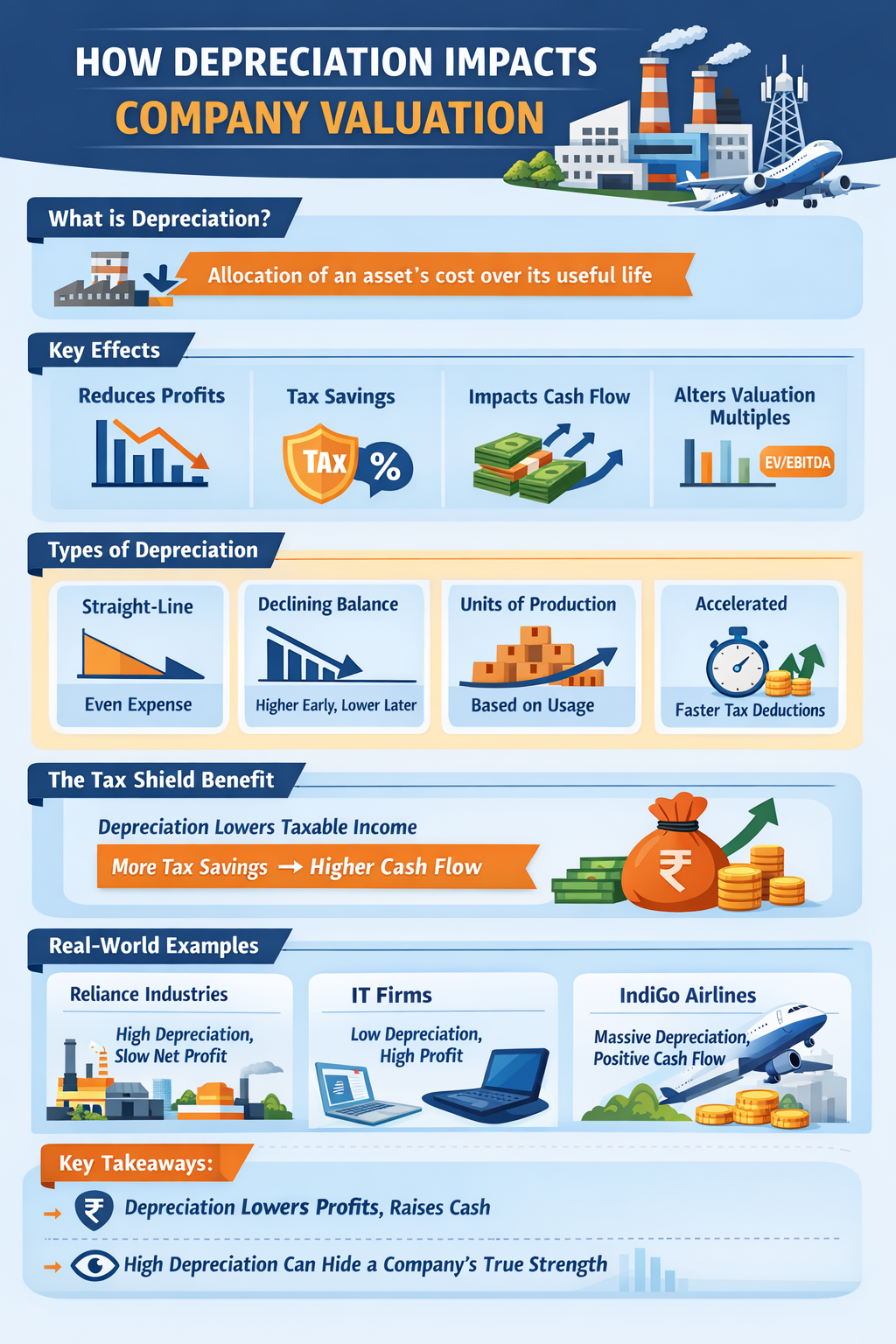
In Simple terms, depreciation is the wear and tear of an asset whereas ‘The Chartered Accountants of India (ICAI)’, defines depreciation as ‘It is the systematic allocation of an asset's depreciable amount over its useful life. The depreciable amount is the cost of an asset minus its residual value. It is a measure of the loss in value of a depreciable asset from use, wear and tear, effluxion of time, or obsolescence’. It appears as an expense on the income Statement, which results in profit reduction. That is why it becomes an important topic in Valuation Models
Suppose, a company purchases a Machinery for Rs. 25,00,000 with a useful life of around 10 Years. The depreciation if recorded at the rate of 10% p.a. will be around Rs. 2,50,000 every year. This reduces the life of the machinery every year, making it a scrap at the end of its life.
Why Does Depreciation Exist In Accounting?
Depreciation exists in accounting mainly for two following reasons:
A) Assets Wear and Tear
An Assets loses its value due to various reasons like-
• Technological advances
• Time
• Usage, etc.
B) Matching Principle
Under Accounting, it’s important to recognize expense which help in generating revenue. Fixed Assets such as machinery, land & building provide us long term benefits, their cost must also be identified and recorded
What Are The Types Of Depreciation And Its Impacts On Valuation
Depreciation is differentiated on the basis of Shift of timings of expenses and tax savings:
1. Straight-Line Method of Depreciation-
Annual expense remains constant over the asset's life span. Impacts the method of retirement as the asset's value declines steadily and consistently.
2. Written Down Value Method or Declining Balance Method-
The depreciation is higher in the earlier years and decreases as you progress through the asset's life. The impact is that the taxable amount is reduced earlier, so the cash flow is larger earlier, which results in a higher NPV.
3. Production Method of Depreciation-
Depreciation is calculated depending on how much product was produced as opposed to when it was produced. The effect of this method is that the expense would correlate with production from revenues, thus it is beneficial to manufacturing companies.
4. Accelerated Depreciation for Tax Purposes-
Tax authorities may allow for more rapid depreciation. This leads to increased cash flows in the early years of an asset's life and thus increases the impact on discounted cash flow valuations greatly.
How Depreciation Appears In Financial Statements
All three primary financial statements reflect depreciation, and their combined effect on valuation should be noted.
1. The Income Statement:
Depreciation is a non-cash expense, and as such, it will reduce both operating income (EBIT) and net income, but no cash will have been spent. For valuation multiples such as EV/EBITDA, depreciation is added back to EBIT; therefore, it has no effect on the valuation. However, for P/E ratios, which are based on net income, an increased amount of depreciation lowers net income; thus, in theory, it may create an undervalued company, especially in capital-intensive industries.
2. The Balance Sheet:
Depreciation is a contra-asset; therefore, it reduces net property, plant, and equipment (PP&E). Depreciation will ultimately impact the company's book value. In addition, book value is important in asset-based valuations, including net asset valuations for companies in the manufacturing and real estate industries. If assets are over-depreciated, the company could be undervalued, especially in M&A situations, if the market value exceeds the book value. The difference between the market value and the book value represents the company's “hidden value.”
3. The Cash Flow Statement:
The indirect method reflects depreciation by adding it back to net income as an operating cash flow (OCF). By doing this, it emphasizes that depreciation is a non-cash expense; thus, OCF should be a better representation of free cash flow (FCF) in a discounted cash flow (DCF) valuation than net income would be-
FCF = OCF - CapEx + Adjustments.
Since depreciation is an approximation of replacement cost, the amount of depreciation can be estimated to provide a company’s maintenance capital expenditure requirements.
The critical relationship between high depreciation and tax shielding in leveraged buyouts (LBOs) leads to better debt serviceability, which results in higher valuation. High-growth technology companies that operate with limited physical assets experience minimal depreciation. This causes their focus to shift toward intangible assets.
Auditors perform a thorough evaluation of estimates; accounting changes become apparent when companies adjust their useful life or methods because these changes affect the ability to compare financial statements. Organizations that operate worldwide face increased depreciation risks because their assets exist within depreciating currency systems.
Analysts must perform a detailed analysis of financial statements to understand depreciation impact because they need to reverse its effects, which hide cash flow amounts, but keep its representation of asset reduction.
Depreciation Reduces Accounting Profit
Depreciation cuts into your profit, even when you're not spending any actual money. This can make a company look worse than it is, but it's just how accounting works.
Like, say a company buys ₹10 lakh worth of equipment and depreciates it by ₹1 lakh each year. That ₹1 lakh comes off the profit yearly, even though the cash isn't leaving. This messes with ratios like P/E and EV/EBIT, which are based on earnings. So, a company with a lot of depreciation might look like it has low profits, but it could still be in good shape.
Depreciation And The Tax Shield Effect
One cool thing about depreciation is that it lowers the amount of income you pay taxes on. When you pay less tax, that's more money in your pocket. This tax savings is called a depreciation tax shield
Here's why tax shields are great:
•Less tax means more cash.
•More cash can boost what a company is worth.
Example:
Let's say depreciation is ₹8 lakh and the tax rate is 30%.
The tax saved would be 30% of ₹8 lakh, which is ₹2.4 lakh..
That ₹2.4 lakh stays with the company, boosting its free cash flow, and often makes the company worth more.
Examples How Depreciation Affects The Overall Company
1. Reliance Industries (Jio + Retail + Petrochem)
Jio industries have Assets like towers and cables which results in High Depreciation amount.Also, the old petrochemical plants have high depreciation. Hence Reliance Industries show huge cash flows but have a very slow net profit.
2. IT firms
IT firms like TCS, Capgemini have very less Machines and hence their depreciation is very low. Their Profits are as approximately equal to their Cash Flow.
3. IndiGo Airlines
IndiGo Buys hundreds of Aircrafts and hence they have massive depreciation. In the year 2020-21, it showed loss but their Cash flows were positive. Smart Investors at the beginning stage, bought these stocks at cheaper prices and now its one of the top performers.
Conclusion
Depreciation isn't just some accounting thing. It has an impact on profits, taxes, cash, ratios, and how much a company is worth. Since figuring out a company's worth usually looks at future cash, depreciation really changes how investors see a company.
If you add up business comprehension, good modelling practices, logical forecasting, being mindful of the cash flow, using visualization tools, communication, and curiosity, you will have the advantage of a finance position at any company.
Basically:
•Depreciation can lower profit but raises cash.
•Depreciation might make a company seem weak, but it can make it valuable.
People often don't get companies with high depreciation. Their profits seem low, but they're actually strong and have good cash potential. If you get what depreciation is about, you can see past the basic numbers and tell if a company is doing well.
About the Author:
Finance professional with hands-on experience in financial modeling, valuation, and corporate finance. Passionate about simplifying complex finance concepts for investors and professionals.