
How to Build a Discounted Cash Flow (DCF) Model
What is a DCF model?
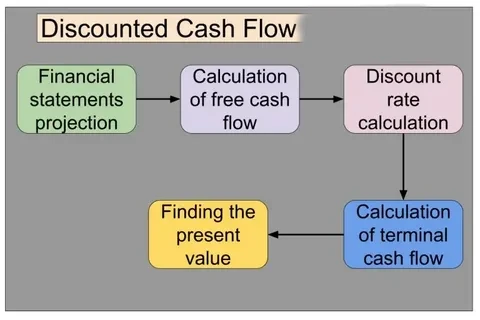
The DCF model, in very simple words, is a way of calculating the value of a company today on the basis of its future cash flows. In other words, the argument is that money in the future equals little or no cash today owing to inflation, risk, and because one cannot use this money for some other good or service now. For example, a DCF model will bring forward future earnings into present terms by bringing them back to the present.
Estimate Free Cash Flows (FCF)
The heart of any DCF model is the company's free cash flow, basically cash a company generates
after it has covered its operating expenses and capital expenditures like buying new equipment or
investing in growth. Its money left over to return back to investors; therefore, it is the number on
which the DCF model hinges.
How you forecast it:
1. Estimate Revenue Growth:Estimate a number for the company revenues for the next few years. This would be based on historical growth rate for the company, what the industry is expected to do or guidance from management. Generally, you will estimate revenue 5 to 10 years.
2. Calculate Operating Expenses and EBIT:Net off all the operating expenses, be it salary expense, rental, or cost of goods sold. That is Earnings before Interest and Taxes, or EBIT. This is how much money the company generates from its core operations before it pays any interest or taxes.
3. Taxes:Deduct the taxes paid. Applying this, we get the Net Operating Profit after Taxes, or NOPAT. The NOPAT is what the firm gets to keep after the government has taken its share.
4. Lower Capital Expenditures (CapEx):This represents the cash the business requires reinvested to sustain or expand itself-that is, new machinery, new buildings, new technology, et cetera. Cash here is being used and not available for distribution to investors.
4. Adjust for the Changes in Working Capital:It is the amount a company requires to operate on a day- to-day basis. The change in working capital related to items like inventory and accounts payable will impact cash flow, and therefore FCF shall be adjusted as well.
Determine a Discount Rate
Having projected the company's cash flows into the future, you next discount them back to a present value. You observe that money in the future is worth less than money currently available. But what discount rate do you use?
WACC Formula can be presented in a simplified mathematical form as follows: WACC= [E / V] × Cost of Equity + [D / V] × Cost of Debt × (1 - Tax Rate)E = market value of equity
D = market value of debt
V = total value, or sum of debt and equity
There are two primary methods of calculating terminal value.
Cost of Equity is generally determined by reference to CAPM. This takes the risk of investing in the company compared to the risk associated with the general market.
Calculation of Terminal Value
Since the cash flows of the company cannot be projected into infinity, we make use of a shortcut known as terminal value in order to estimate and approximate the value of the company beyond our forecast period, and this forecast period is at least 5-10 years. It therefore represents all cash flows remaining from that point into infinity.
There are two primary methods of calculating terminal value.
1. Perpetual Growth Method This considers that the cash flow of the company will continue to grow infinitely. A relatively low growth rate, in the form of long-term GDP or inflation rate, is applied.
Terminal Value = Last Year FCF × (1 + Growth Rate) WACC - Growth Rate \\
2. Exit Multiple Method It is a method in which a multiple-like an EBITDA multiple-driven by comparable companies in the same industry, is applied.
Discounting Cash Flows to Present Value
You take all the cash flows and the terminal value and bring them back to the present using the discount rate, WACC. Thus, you have a PV for every cash flow in every single year.
Discounting each year's cash flow by the discount rate is described as follows:
PV of FCF = FCF/(1 + WACC)^n
Calculating Equity Value
Subtract net debt - total debt, minus cash - from enterprise value to find out how much the company is worth to shareholders. This will be equity value.
Equity Value = Enterprise Value - Net Debt
Equity value is what amount, according to the DCF model, the company's shares are worth today. You compare this value to how highly the company is priced in the market right now, as found by taking its current market capitalization.
Sensitivity Analysis
Lastly, a sensitivity analysis must be done to see the effects of changes in assumptions, especially on the most important assumptions such as revenue growth, WACC or terminal growth rate, on the valuation. This would therefore make you see the kind of uncertainty that bases the valuation and risks that are attached.