
Financial Statement: Create Financial Statement Step by Step
Introduction to Bonds
A financial statement is an account prepared by a company that reflects the financial operations and health of the firm. In many countries, government agencies as well as other external accountants audited financial statements for their confirmation and tax, financing or investment purposes.
The main financial statements for for-profit businesses are a balance sheet, an income statement, a statement of cash flow, and a statement of changes in equity. The nonprofit entities use a very similar set of financial statements. However, the names are slightly different and so is the communication.
Preparing financial statements is an important and difficult work-it's something you should do well to keep your business up and running.
These statements are essential for analyzing a firm's financial performance. It will enable companies to make the right decisions and identify areas in which they can thrive and become better. Financial statements also enable companies, small and large alike, to be equipped with information that helps them handle their costs well.
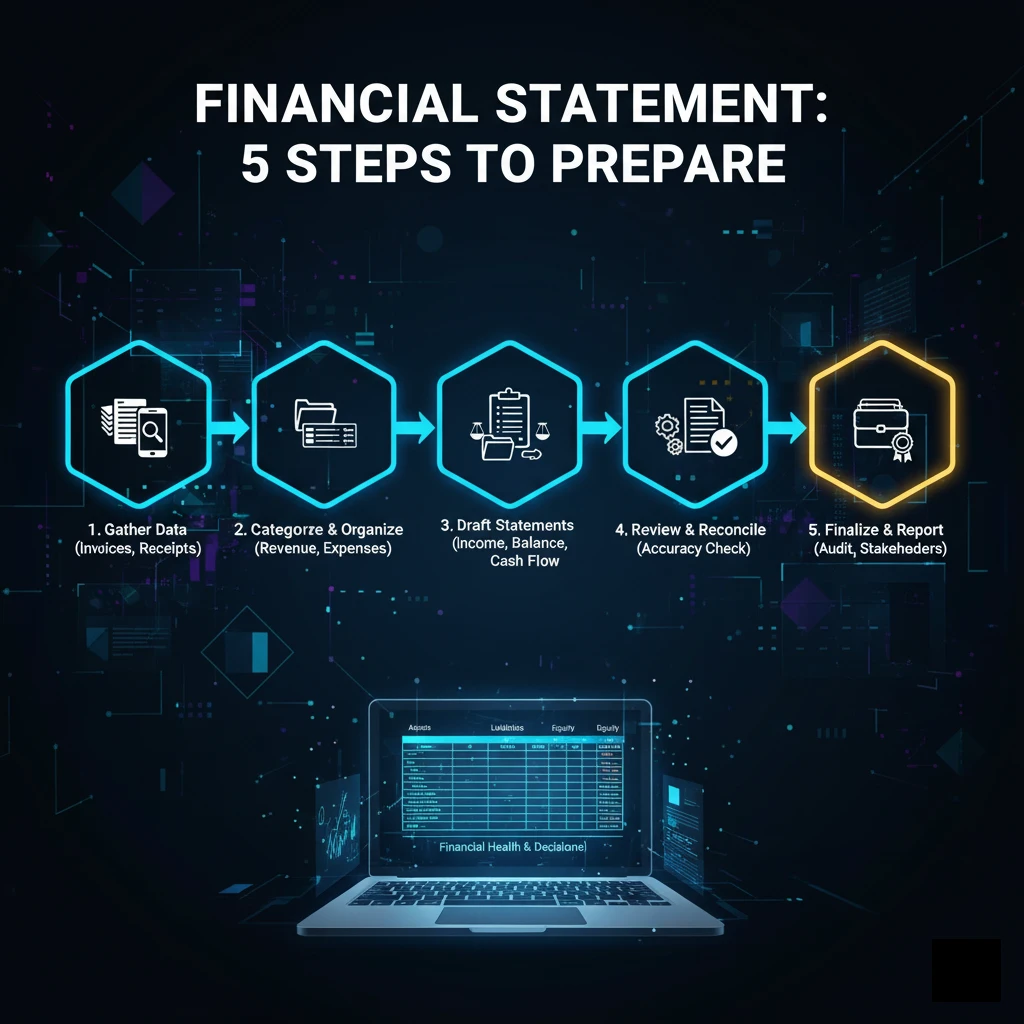
Five step to prepare your financial statement
The preparation of financial statements begins by collecting all your financial information and putting it on official documents. In that polished and finalized form, financial statements are distributed to relevant stakeholders such as management, investors, and creditors, for their use in evaluating the performance, cash flow, and financial health of the corporation.
Step 1. Gather all the relevant financial data
Before you do anything, you need to collect all the data relevant to financial data, including sale
invoices, receipts, bank statement, and expense reports. This step provides you the foundation
of the entire process. The compiled data gives a vivid image of the financial standing of your
business, and through it, you will discover spots that require cutting costs so you are well-
positioned to make the most informed decisions.
This can be daunting - at least for everyone: no one enjoys sifting through a pile of receipts or manually keying information from expense reports, but it does't have to be that way if you use the proper tools. We recommend using a software product that lets you scan receipts in real time, thus automatically capturing the details of transactions and thereby avoiding errors such as underreporting or overreporting.
Step 2. Categorize and organize the data
Once you have prepared the data for financing, it is time for sorting and filing. You should
categorize data into revenue, expenses, assets, and liabilities.
Well-arranged datasets will make drafting easier; then you are able to meet reporting deadlines, which again translates to passing regulatory requirements. It means you can talk their language which accounts for accounting standards, you keep stakeholders' trust, and you avoid legal problems.
To be very prepared for this step, choose a pre-accounting software which will collect your financial data and organize them in real time. Instead of waiting until the last minute to sort and file every expense you get, the software will automatically scan or upload them for you at the instance when they received.
Step 3. Draft preliminary financial statements
With the collected data, it times to start drafting the preliminary financial statements. This
involves three types of statements; an income statement, a balance sheet and a cash flow
statement.
How to draft an income statement
An income statement should be like your business report card. It reports whether your business has been profitable or not within a certain period of time. Here is the easiest way to prepare one:
A). Write down all your company's revenues:This can include when you sell your goods or services, investing money, or any other way your company generates cash. In total, this is called Revenue.
B). Estimate the Cost of Goods Sold:These are the costs of the money you spent to manufacture the products or services sold.
C). Subtract this amount from revenue:This gives you Gross Profit.
D). List all regular costs:These could include items such as rent, utility bills, salaries for staff, and advertising.
E). Subtract these costs from gross profit:That gives you Operating Income.
F). Account for other costs and gains:These can include items such as taxes, interest, and other unusual income or expenses
G). Net income calculation:This is profit after the company has incurred all expenses and costs. It only indicates if the company is profitable or not.
How to draft a balance sheet
A cash flow statement is very similar to your company's bank statement. It simply outlines how cash comes in and goes out over a certain period. Here is how to draft one:
1) You start with net income:This is on the income statement.2) Then you need to adjust the non-cash items as well as the changes in working capital:accounts like accounts payable, and amounts owed to the company which are known as accounts receivable.
3) Cash from investment:This is money invested or generated from the purchase and sale of investments such as equipment, property, or stocks.
4) Cash from financing:This is cash generated from activities like issuing stocks or loan settlements.
5) Add it all together:This gives you the net change in cash. Add this to the starting cash to get the ending cash balance.
Step 4. Review and reconcile all data
This is all about accuracy. Review each entry, reconcile your data to your company's records with external documents from banks and other sources. Run your math through on gross profit, ensure the income is correct, and whatever you've written down for debts and taxes should be matched. All this diligent validation ensures that mistakes are prevented-giving the wrong impression about the financial health of your company.
With Expensify integrations, accounting and expense management software can team up to help highlight discrepancies or mismatches for you, making your review as smooth as possible and helping you identify and correct errors right away.
Step 5. Finalize and report
You are almost there. After you have checked through all your statements, you are now prepared to complete your statements for reporting purposes. For a small to medium-sized business, this might include having the statements audited or reviewed by an external accountant to ensure they meet the relevant standards and regulation.
Remember, these statements are a mirror reflecting the financial stature of your business to stakeholders and helps in securing loans and attracting investors and making appropriately informed business decisions. Thus, accuracy and integrity rank paramount importance.